Monday, March 7, 2011

Question 2

How was symbology used in ancient Greek art and has it affected later artworks?

Symbology was used extensively in ancient Greek art, mostly to set the Gods aside from normal people, and to make it easier to distinguish between them. It gave them more power, or more wisdom, or beauty, depending on how they were painted. Zeus, Poseidon and Hades, being the three most powerful Gods, had symbols of strength and authority. Zeus had a lightening bolt for power and an eagle for cunning and regalement. Poseidon had a trident for his power and authority. He was also sometimes painted with a fish tail, to symbolize his kingdom, and wild hair and beard, to show the freedom and untamability of the sea and all it represents. Hades was depicted on a throne and with a laurel wreath in his hair to symbolize his regalement. These three powerful Gods were all depicted with beards. In ancient Greece men were seen as dominant over woman, and the beard, as a sign of manliness, was then given to the powerful Gods, to show their dominance over others.

In more modern artworks, the same kind of symbology was used. Davids 'The Oath of Horatii', painted in 1784, shows a man facing his three sons and making them swear an oath to fight and kill the Curatii brothers. The father is the dominant man in this painting, and is the the only one with a beard. This compares to Zeus, Poseidon and Hades, the dominant Gods, who also all have beards. Also, the father is wearing a long red cloak, which again symbolises strength and passion, and the caption quotes "Red - the colour of passion - becomes the colour of the revolution."

Another example of symbology in later artworks can be seen in another of Davids works, 'Lictors bringing back to Brutus the bodies of his sons'. This painting is showing the bodies of Brutus' sons being brought home after Brutus orders their deaths. Brutus is sitting in the dark to the side, and is sitting on a throne, or a lavish chair. Like in the instance of Hades, the throne symbolizes the power Brutus has or had, like the power to order the deaths of his sons.

Symbols are timeless, and have been used in paintings and drawings for as long art has been around. It gets across a message that [something] alone cannot, and strengthens the personality of the characters depicted. Whether it's the trident of Poseidon, that sets him apart from the other Greek Gods, the [something about mythological creature], or the adding flourish to a renaissance piece of art, symbology has been hand-in-hand with art since the day of its creation.

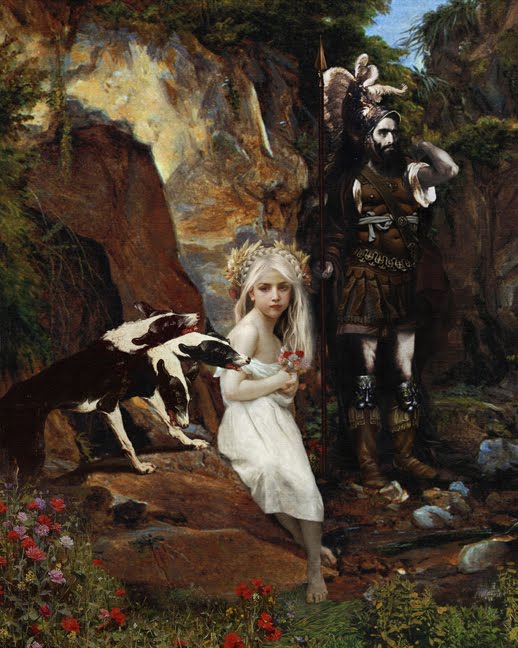
Hades - Question 1


- Not many later paintings of Hades
- In writing has changed into the devil
- underworld changed to hell ect.

Sunday, March 6, 2011

Question 1

How were the Gods portrayed in ancient Greek art and how has that changed over time?

In Ancient Greek mythology the Gods were seen as the founders of life and everything in it. They were the reason behind all unexplained phenomenon and the justification of why people acted as they did. The Greeks found many ways to portray them, and the easiest to see is in their artwork. The ancient Greek people painted mostly on vases and pots, and these are some of the first known paintings of the Greek Gods.

The Gods portrayed on the pots are easy to recognize because they have distinctive features and stances that set them apart. For instance, Zeus was always depicted with a beard and a lightening bolt. These all symbolize strength, cunning and wisdom, and have been carried throughout art history along with Zeus.

Although our view of art has changed, Zeus and how he is depicted has not. He is a figure of strength and authority, and artists associate that with manliness, symbolised with a beard, no matter what time they lived in. This statement is strengthened by the painting 'Zeus and Thetis' by Anton Losenko. It was painted in 1769, hundreds of years after the original pot paintings, and depicts Zeus wearing nothing but a red cloth. This differs from the ancient pot paintings by the absence of either the lightening bolt or the eagle, and instead has a red cloth, the colour of strength and power. The main similarity in both pictures of Zeus is his beard. This also applies to Poseidon. He was a powerful God, and was also depicted with a beard in all paintings of him. This can be seen in the painting 'Neptune and Amymone', with Neptune being the Roman equivilent of Poseidon.

Hades image, however, as changed dramatically. In ancient Greek mythology Hades was the God of the underworld. But over time people have changed him into the Devil, and the underworld into hell. Hades was depicted, in ancient paintings, with a laurel wreath around his head, and is usually painted on a throne. This gave him a feeling of royalty and power. In modern art the devil, or the new Hades, is shown holding a forked trident, and sometimes has horns and a forked tail. This can be seen in the painting 'Saint Michael Vanquishing the Devil', painted in 1530 by Bonifacio Veronese, picturing a saint defeating a devil with wings and small horn coming out of his head. This changed his image and his personality by making him seem more vindictive and evil.

As the world has grown and evolved, so too has art and the ideas behind it. As new techniques were discovered, the ways of portraying the Gods of ancient mythology has evolved as well, sometimes subtly, in the case of Zeus and Poseidon, and sometimes hugely, like Hades and the underworld. But nothing has remained completely the same from the ancient Greek pot paintings.

Wednesday, March 2, 2011

Zeus


First Zeus: www.theoi.com/Olympios/Zeus.html
Second Zeus: www.wikigallery.org/wiki/painting_254325/Anton-Losenko/Zeus-and-Thetis-1769
Third Zeus: www.occultopedia.com/z/zeus.htm

Poseidon

http://www.theoi.com/Gallery/K2.3B.html
http://www.bestofalltopics.com/poseidon-pictures-and-info/

- Ancient Greek Poseidon is flat, with no 3D-ness, face turned side on. They both have a beard, symbol of power, and a trident, of different designs, but with the same symbolic meaning.
- Both have an angry, powerful expression on their faces
- Newer one has minimal clothing, and ancient one has war gear on, both showing strength

Questions for 90250 internal

1. How were the Greek Gods portrayed in ancient art and how has that depiction changed over time?
2. How was symbology used in ancient Greek art and has it affected later artworks?
3. How significant is Greek mythology in more modern art?

Second Load of Notes


Great Modern Masters

Edgar Degas
- Painted mostly with rough brush strokes, faces faded and slightly blurred
- Features a lot of music playing and dancing, having fun
- A few paintings depict normal scenes, and show the calm and contentment of the people in them
- Aspects of mythology used, like hard work, good people in Greek mythology were hard workers...

examples:
- 'The rehearsal' (http://www.poster.net/degas-edgar/degas-edgar-the-rehearsal-on-stage)
- 'The orchestra' (http://www.nga.gov/feature/artnation/degas/thepainting_1d.htm)
- 'The cotton market, New Orleans' (http://hubpages.com/hub/Edgar-Degas---French-Impressionist)
- 'Girls combing their hair' (http://steveartgallery.se/picture/image-37722.html)